


I burned my first batch. Not dramatically—more like a sad, gummy clump that welded itself to the pan and basically dared me to try again. But once I actually cracked the two-ingredient method, weeknight dried pasta became a distant memory. Never went back.
Fresh pasta sounds intimidating. It really shouldn’t. This is one of the oldest kitchen skills in human history, and your Italian great-great-grandmother wasn’t running a KitchenAid or dropping $400 on a pasta machine from Williams Sonoma. She had flour, eggs, and her hands. That’s the whole setup.
The Two Ingredients (And Why They Matter More Than You Think)
Flour and eggs. Full stop.
But here’s the thing—not all flour behaves the same, and this is exactly where most beginners torpedo themselves before they’ve even cracked an egg. “00” flour is what you want if you can track it down. It’s a finely milled Italian flour that produces silkier, more elastic dough than standard all-purpose. Bob’s Red Mill carries it at most grocery stores, usually $4-5 a bag. Can’t find it? All-purpose is genuinely fine. Just stay away from bread flour or cake flour—both will fight you.
For eggs, go large, and pull them out of the fridge 30 minutes early. Room temperature matters. Cold eggs don’t incorporate smoothly and your dough will feel like it’s actively resisting you.
The ratio you need to memorize: 100 grams of flour per egg. Two servings means 200g flour and 2 eggs. You’ll have it memorized after your first attempt.
How to Actually Make the Dough
Dump your flour onto a clean surface and form a well in the center—think little volcano crater. Crack the eggs straight into it.
Grab a fork and beat the eggs gently, slowly dragging flour in from the edges as you go. This takes maybe 3-4 minutes. Once you’ve got a shaggy mass forming, ditch the fork entirely and work it with your hands. Knead for a solid 8-10 minutes until the dough feels smooth and slightly bouncy—poke it, and it should spring back at you. Sticky? Add flour, but just a pinch at a time.
Wrap it in plastic. Let it sit at room temperature for at least 30 minutes. This step isn’t negotiable. The gluten needs to relax or rolling it out will feel like trying to flatten a rubber band, and not in a satisfying way.
Rolling It Out (With or Without a Machine)
You don’t need a pasta machine. A rolling pin and a little patience gets you there.
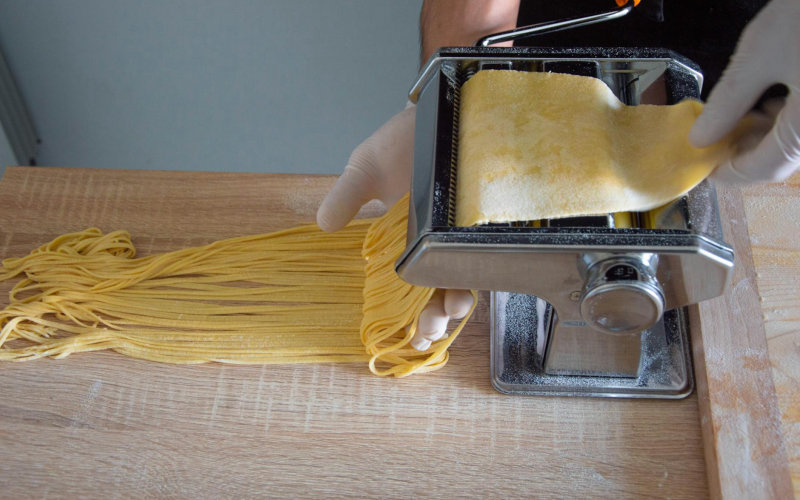
If you do have a machine, start at the widest setting (usually “1”) and run the dough through several times, folding it between passes. Work down to setting 5 or 6 for most shapes. My Atlas Marcato—bought it in 2019, still going strong—makes this genuinely quick, around 10 minutes total for two portions.
Rolling by hand, shoot for about 2mm thickness. Here’s a useful trick: hold the sheet up to the light and you should just barely make out your hand shadow through it. That’s your target. Hit that and you’re golden.
Cutting and Shaping
Tagliatelle is your best friend as a beginner—it’s forgiving. Roll the dough into a loose log and cut strips about 6mm wide. Shake them loose with a little flour so nothing clumps together.
Want something even more foolproof? Go pappardelle. Cut at 2cm wide. Basically impossible to ruin.
Cooking Fresh Pasta
Fresh pasta cooks fast. Aggressively fast. We’re talking 2-3 minutes in heavily salted, boiling water—not the 10-12 minutes you’re used to with dried. Taste it at the 2-minute mark and go from there.
And don’t rinse it. Ever. The surface starch is what makes sauce actually cling to every strand instead of sliding off.
Bottom Line
Here’s something nobody mentions: fresh pasta tastes better when the dough is slightly under-kneaded than slightly over-kneaded. Over-worked dough turns tough and chewy in a way that no amount of extra cooking time salvages. Under-kneaded dough might show a rough patch or two, but it still eats beautifully. So if your arms are burning at minute six? Stop. Call it done. Your pasta will be absolutely fine.
Frequently Asked Questions
Can I make homemade fresh pasta without a pasta machine?
Absolutely. A standard rolling pin works perfectly well—it just takes more elbow grease, maybe an extra 5-10 minutes of rolling. But the result is identical. Plenty of pasta purists actually prefer hand-rolled over machine-rolled.
Why does my pasta dough keep tearing when I roll it?
Two likely culprits: you didn’t rest the dough long enough, or it’s too dry. Add a tiny splash of water (we’re talking half a teaspoon), work it in, and let the dough rest another 15 minutes before you try again.
Can I make this dough ahead of time?
Yes. Wrapped tightly in plastic it keeps in the fridge up to 2 days. Just let it come back to room temperature for about 20 minutes before rolling, otherwise it’ll be stiff and stubborn.
Is “00” flour really necessary for beginners?
No. It does make a noticeably silkier pasta, but all-purpose produces a totally respectable result. Start with whatever’s already in your pantry. Once you’re comfortable with the process, try “00” flour and taste the difference for yourself.
Photo by Valeria La terra on Pexels