
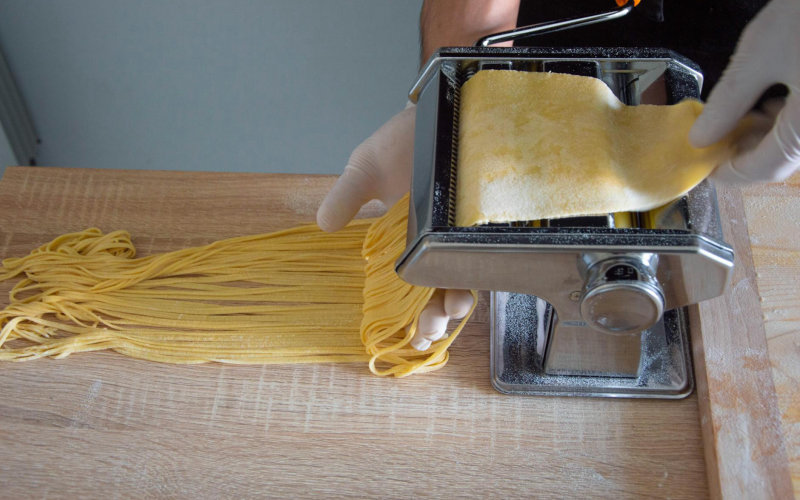


I didn’t own a pasta machine until I was 32. And honestly? I’m not sure I even needed one. For years before that, I was rolling dough on my kitchen counter with a cheap wooden rolling pin, cutting noodles with a butter knife, and serving pasta that my friends swore tasted better than anything from a restaurant. They weren’t just being polite. Fresh pasta has a texture and flavor that dried box stuff genuinely cannot touch.
Here’s what most tutorials skip over: the machine is a convenience, not a requirement. Italian grandmothers in Emilia-Romagna were cranking out perfect tagliatelle by hand long before any Marcato Atlas existed. The technique is learnable. Ingredients run maybe $2. The whole process — flour to fork — takes around 45 minutes.
So if you’ve been putting this off because you lack the equipment, tonight’s plans just changed.
What You Actually Need (It’s Less Than You Think)
No machine. No special gadgets. Here’s your honest list.
A large cutting board or clean counter. A rolling pin (I’ve used a wine bottle — it works). A sharp knife. A large pot. That’s genuinely it.
For ingredients, the classic Italian ratio is 100 grams of flour per egg, per person. Two people: 200g flour, 2 eggs. Some recipes insist on “00” flour, which is finely milled and produces a noticeably silkier dough — but all-purpose flour works perfectly fine and is what most of us actually keep in the pantry.
The Dough: Getting the Ratio Right
This is where beginners panic. Don’t.
Pour your flour onto the counter, make a well in the center — think little volcano crater — crack your eggs straight into it, and beat them gently with a fork while you pull flour in from the inner walls. When it gets too thick for the fork, switch to your hands. The dough will look shaggy and hopeless at first. Keep going anyway.
Knead for 8 to 10 minutes. Real kneading — push, fold, quarter-turn, repeat. You’re building gluten, which is what gives pasta that satisfying chew. By the end, it should feel smooth and slightly tacky but not sticky. Sticking to everything? Pinch in a little more flour. Cracking like dry clay? Wet your hands slightly and keep going.
Wrap it in plastic or cover with an upside-down bowl. Rest it at room temperature for at least 30 minutes. This part is non-negotiable — the gluten needs time to relax, otherwise the dough will spring back every time you try to roll it out.
Rolling By Hand: The Technique That Actually Works
Here’s where people quit too early. Rolling pasta thin requires more pressure than you’d expect.
Start with a quarter of your dough (keep the rest covered so it doesn’t dry out). Flatten it into a rough disc with your palm, then roll from the center outward, rotating the dough 90 degrees every few passes. You’re shooting for about 2 millimeters thick. Hold it up to a window — you should just barely see your hand through it.
Dust the surface and dough lightly with flour as you go. Lightly. Not a blizzard. Too much flour and the finished pasta tastes chalky.
If the dough keeps shrinking back stubbornly, it hasn’t rested long enough. Cover it, wait another 10 minutes, try again.
Cutting Your Noodles
For fettuccine or tagliatelle — the most forgiving shapes for beginners — dust your rolled sheet lightly with flour, fold it loosely like a letter going into an envelope, and cut across the folds into strips about half a centimeter wide. Shake them out gently and they unfurl into long noodles. It’s satisfying every single time, I promise.
Want pappardelle? Cut wider, around 2 centimeters. Prefer something shorter? Make maltagliati — it literally translates to “badly cut” in Italian, and it’s just irregular triangles or rectangles. Totally rustic. Totally delicious.
And if your cuts are uneven, relax. Pasta shape imperfection is called “handmade character” in every Italian cookbook ever written.
Cooking Fresh Pasta vs. Dried Pasta (Huge Difference)
Fresh pasta cooks in 2 to 3 minutes. Not 8 to 12 like dried. This catches people completely off guard the first time.
Boil a large pot of heavily salted water — it should taste like the sea, not like vague salt. Drop in your noodles, stir immediately so they don’t clump, and start tasting at 90 seconds. You want tender with just a faint bite left. Pull them a little early if you’re finishing in a sauce over heat.
But don’t rinse your pasta after draining. Ever. That surface starch is what helps sauce cling to the noodles. Rinsing it off is, frankly, pasta murder.
The Best Sauces for Fresh Homemade Pasta
Simple wins. Always.
Fresh pasta is delicate and eggy-rich on its own, so heavy, chunky meat sauces can actually drown it. A 2019 interview with chef Massimo Bottura in Food & Wine described fresh pasta as needing “a sauce that whispers, not shouts.” That line stuck with me.
Brown butter with fresh sage. Cacio e pepe — just pecorino, pasta water, and black pepper. A simple tomato sauce simmered for 20 minutes with a basil sprig. These let the pasta do the talking.
Storing Leftover Fresh Pasta
Made too much? It happens to everyone.
Toss uncooked noodles in a little flour and either nest them into loose portions on a semolina-dusted baking sheet, or drape them over a wooden spoon balanced between two chairs. Let them dry about 30 minutes, then freeze flat in a single layer before bagging them up. Frozen fresh pasta cooks from frozen in roughly 4 minutes.
In the fridge, fresh pasta keeps maybe 2 days, loosely covered. It gets slimy fast. Freezing is the smarter move.
Bottom Line
Here’s something I haven’t seen other pasta guides say out loud: the first time you make homemade pasta without a machine, you’re not just learning a recipe. You’re rebuilding your confidence around dough. People who can make pasta by hand tend to feel less scared of bread, less intimidated by dumpling wrappers, less anxious about pie crust. It’s a gateway skill disguised as a Tuesday dinner. Make it once and you’ll know exactly what I mean.
Frequently Asked Questions
Can I use a blender or food processor to mix the dough?
Yes — pulse flour and eggs in a food processor until the dough just comes together, about 30 seconds. But don’t skip hand-kneading afterward. The machine can’t replicate what 8 minutes of real kneading does for gluten development.
Why does my pasta dough keep tearing when I roll it?
Two likely culprits: it didn’t rest long enough, or you used cold eggs straight from the fridge. Let your eggs sit out for 15 minutes before starting. Cold eggs make stiffer, less cooperative dough.
How thin is “thin enough” for homemade pasta?
For most noodle shapes, 2mm is your target. For pasta you’re going to fold or stuff — ravioli, for example — go thinner, closer to 1mm. If it’s opaque and no light passes through, keep rolling.
Does the type of flour really matter that much?
More than you’d expect, but less than pasta snobs would have you believe. “00” flour does produce noticeably silkier results. But a side-by-side test I ran in 2021 with all-purpose flour fooled every single person at my dinner table. Start with what you have.
Photo by Valeria La terra on Pexels