
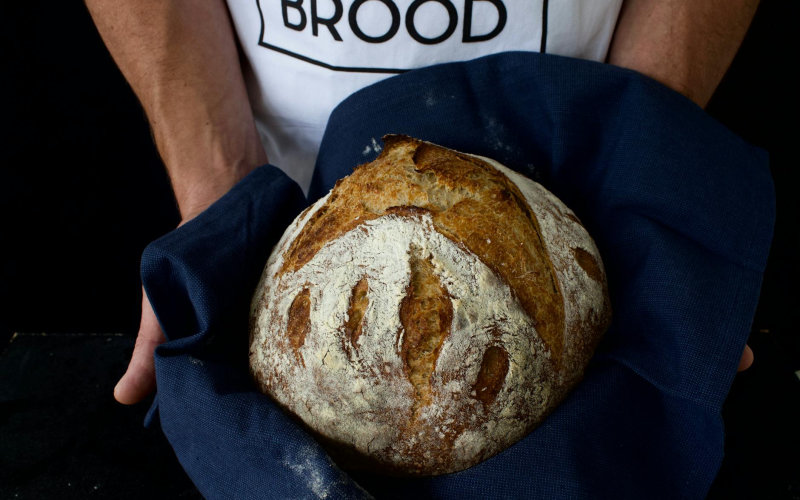


I burned my first three sourdoughs. Flat, dense, gummy — the kind of loaves you could legitimately use as a doorstop. And I had a stand mixer sitting right there on the counter the whole time. So when people ask me whether you can make great sourdough completely by hand, I almost laugh. Not because it’s a ridiculous question, but because the mixer was never actually the point.
Hand-mixing sourdough is older than any machine ever built for the job. Bakers in 1800s San Francisco were cranking out gorgeous open-crumb loaves with nothing but flour, water, salt, and seriously callused hands. The technique exists. You just have to learn it.
Here’s what nobody tells you upfront: your hands beat a stand mixer in certain ways. You can feel the dough change beneath your palms. You sense when the gluten network tightens up. A KitchenAid can’t do that.
Build Your Starter First (This Takes About 7 Days)
You can’t skip this step. No workaround exists.
A sourdough starter is just flour and water that you feed daily until wild yeast and bacteria move in and colonize it. Mix 50g whole wheat flour with 50g room-temperature water in a jar. Every 24 hours, discard half and feed it again with fresh flour and water.
By day 4 or 5 you’ll see bubbles. By day 7 it should double in size within 4-6 hours of feeding — that’s when it’s ready. Use it before it collapses back down.
The Ingredients Are Genuinely Simple
Four things. That’s it.
For one loaf you need 450g bread flour, 325g water (roughly 72% hydration, which is forgiving for beginners), 90g active starter, and 9g fine sea salt. Avoid table salt if you can manage it — it can inhibit fermentation.
Don’t obsess over brands early on. King Arthur bread flour is solid and consistent, but honestly? Whatever’s on the shelf at your grocery store will work fine while you’re still learning how dough should actually feel.
Mixing and Autolyse: The Secret That Saves Your Arms
Combine your flour and water first — without the starter. Stir until no dry flour remains, then cover the bowl and let it sit for 30-60 minutes. This is called autolyse, and it does something almost magical: the flour fully hydrates and gluten begins forming on its own, with zero effort from you.
After autolyse, add your starter and salt. Mix using the “pinch and fold” method — pinch through the dough repeatedly for about 5 minutes. It’ll feel shaggy and strange. That’s completely normal.
Stretch and Fold Instead of Kneading
This is where most beginner tutorials lose people. You don’t knead sourdough the way you’d knead sandwich bread. Instead, over the first 2-3 hours of bulk fermentation, you work through sets of “stretch and fold.”
Every 30 minutes, grab one side of the dough, stretch it upward, fold it over itself, then rotate the bowl 90 degrees. Do that four times around. That’s one set. Aim for 4-6 sets total. Between sets, the dough just sits there doing its own thing.
By set 4, you’ll feel a genuine difference. The dough gets tighter, smoother, and starts holding its shape rather than spreading out like a puddle.
Shaping and the Final Proof
After bulk fermentation (usually 4-6 hours at 75°F), turn your dough out onto a lightly floured surface. Pre-shape it into a rough round, let it rest 20 minutes, then do your final shape — either a boule or a batard, whichever you prefer.
Place it seam-side up in a floured banneton, or a bowl lined with a floured kitchen towel. Cover it and refrigerate overnight (anywhere from 8-16 hours). Cold fermentation is what builds that tangy depth of flavor. So don’t skip it.
Baking: The Dutch Oven Is Your Best Friend
Preheat your oven to 500°F with a Dutch oven inside for at least 45 minutes. Turn your cold dough onto parchment, score the top with a razor blade or a sharp knife, and lower it into the screaming-hot pot.
Bake covered at 500°F for 20 minutes. Remove the lid, drop to 450°F, and bake another 20-25 minutes until the crust is deep brown. Then — and this part kills people — cool it for at least one hour before you cut into it. The crumb is still setting. I know it’s hard to wait.
Bottom Line
Here’s what twelve years of bread baking taught me that most recipes won’t mention: the best sourdough doesn’t come from better equipment or fancier flour. It comes from learning to read your specific dough in your specific kitchen. Your starter is a living thing shaped by your local air, your tap water, your ambient temperature. The baker in Portland making legendary loaves off the same recipe you’re using might get completely different results — because their environment is different from yours.
Stop chasing someone else’s crumb photos. Bake the same recipe six times in a row. That repetition, in your kitchen, with your hands, is the actual teacher.
Frequently Asked Questions
How long does homemade sourdough bread without a stand mixer actually take?
Start to finish, you’re looking at roughly 24-36 hours once you factor in the overnight cold proof. But active working time is surprisingly short — maybe 30-45 minutes spread across the whole day. Most of it is just waiting around.
What if my dough is too sticky to handle?
Really sticky dough usually points to a hydration issue or under-developed gluten. Try wetting your hands instead of adding more flour — counterintuitive, I know, but it stops the dough from sticking to you without tightening the crumb. And do a few more stretch-and-fold sets before you start panicking.
Can I use all-purpose flour instead of bread flour?
You can, but your dough will be softer and harder to shape since all-purpose has less protein (around 10-11% versus 12-13% in bread flour). Start with bread flour if it’s available. Once you know what properly developed gluten actually feels like, experimenting becomes a lot more fun.
Why did my loaf come out dense and gummy inside?
Two likely culprits: underproofing, or cutting it too soon. Gummy crumb almost always means the bread wasn’t fully baked through — or you sliced into it while the interior was still steaming and setting up. Next time, bake it five minutes longer than you think you need to, and wait the full hour before you touch it.
Photo by Jytte Elfferich on Pexels